Construction is the last major industry that hasn't industrialised. I help you become the exception.

As a Guest Speaker at this years (2026) Big5 exhibition and where we discussed various elements concerning Industrialisation & Modular Construction...
SPEAKING
Keynotes, conference sessions, panels and in-house events on the industrialisation of construction, modular and MMC, the classification of construction methods, and the financing and procurement reforms that make or break the sector.
MOTIVATION and LEADERSHIP
For boards, leadership teams, site teams and graduate cohorts who need to understand where the industrialised modular industry is going and what it will ask of them. These are not technical seminars. They are about mindset
One to One
Private time for founders, directors, investors and senior professionals who want a candid conversation rather than a presentation. Typical subjects: whether to invest in a factory; how to read a modular business plan; how to structure a pipeline so that capacity follows demand rather than the other way round; how to move from a site-based career into an industrialised one; and honest second opinions on decisions that are already on the table.
Consultancy
The core of what I do. I work with governments, developers, contractors, manufacturers, investors and housing providers to industrialise how they deliver buildings — from a single programme to an entire national pipeline. A program could run for as little as month to two or more years, to ensure that board approved implementation is put into place.
Often, and in my opinion, wrongly referred as modular construction, Industrialisation is not a product or a building system — it is the reorganisation of the whole process, from demand and design through manufacture, logistics, assembly and handover. The factory is only one stage of that chain. Almost forty years across every stage of it has shown me that the industry's failure to industrialise is not a failure of technology; it is that no single party controls the process from end to end, so each stage optimises for itself and the gains are lost at the handoffs. There is a way forward, and it means rethinking procurement, contracts, design and the role of the contractor as much as the factory floor. It is not an exclusive system but an inclusive one — a way for the existing industry to build better, faster and with less waste.
Industrialisation of construction


Almost every other major industry has industrialised. Construction, the largest of them, has not — despite billions invested and decades of pilots. Why? Not for lack of factories or technology; both exist. Construction still works as supply-to-site-and-build because the demand pipeline is fragmented, procurement is written for site work, and the design, manufacturing and assembly stages are owned by different parties with different incentives. A factory placed into that chain becomes the exception, not the norm. Until the process is brought under one point of control, the factory cannot deliver what it is capable of.
Factory based construction

Excerpt from presentation
One of my quotes from the Industrialisation of Construction presentations

Working with Andrew J Bannister
The industrialisation of construction — and how I can help you get there
Construction has been promised a revolution for as long as I have worked in it. Forty years and four continents later, the factories have arrived but the transformation has not. The reason is simple: industrialisation is not a factory. It is a whole process — land, funding, design, product selection, procurement, manufacture, logistics, assembly, handover and reuse — and almost nobody controls more than two of those stages.
Everything I do is aimed at closing that gap. Whether you want me on a stage for an hour, across a table for a morning, or embedded in your organisation for a year, the subject is the same: how construction becomes an industry, how modular and modern methods fit within it, and what a central point of control looks like when it is built on real data rather than good intentions.
Below are the ways I work, and how each is charged.
Speaking
Keynotes, conference sessions, panels and in-house events on the industrialisation of construction, modular and MMC, the classification of construction methods, and the financing and procurement reforms that make or break the sector.
I speak without slides if the room prefers it, and never from someone else's script. Recent themes include why so many well-funded modular businesses failed, what Japan, Sweden, the United States and Saudi Arabia got right, and why the answer is coordination rather than invention.
How it is charged: a fixed speaking fee agreed in advance, plus travel and accommodation where the event is outside the UAE. Industry bodies, universities and not-for-profit housing organisations may ask about a reduced rate. Panels and moderated sessions are priced separately from keynotes.
Motivation and leadership sessions
For boards, leadership teams, site teams and graduate cohorts who need to understand where the industrialised modular industry is going and what it will ask of them. These are not technical seminars. They are about mindset: why the trades are not coming back, why output per worker is the only number that matters, and what it means to work in an industry that is about to change more in ten years than it did in the previous fifty.
Sessions run from ninety minutes to a full day and can be built around your own pipeline and your own people.
How it is charged: a half-day or full-day rate, agreed in advance, inclusive of preparation. Where a session is tailored to your organisation — using your projects, your numbers and your challenges — a preparation fee is added to cover the time spent understanding them.
One-to-one
Private time for founders, directors, investors and senior professionals who want a candid conversation rather than a presentation. Typical subjects: whether to invest in a factory; how to read a modular business plan; how to structure a pipeline so that capacity follows demand rather than the other way round; how to move from a site-based career into an industrialised one; and honest second opinions on decisions that are already on the table.
Everything discussed is confidential.
How it is charged: by the hour or by the half-day, whichever suits the question. A first thirty-minute conversation is free — it lets us both decide whether I am the right person to help. Regular one-to-one time can be bundled into a monthly arrangement.
Consultancy
The core of what I do. I work with governments, developers, contractors, manufacturers, investors and housing providers to industrialise how they deliver buildings — from a single programme to an entire national pipeline.
That work typically covers:
-
Assessing where an organisation actually sits on the path to industrialisation, and which of the nine stages it controls
-
Selecting construction methods against geography, climate, seismicity, logistics and regulation, using the GUILD Classification of Construction Methods (M1–M5) as a common language for lenders, insurers and clients
-
Designing the central point of control — the governance, data and interface standards that let a supply chain behave as a system rather than a set of components
-
Structuring demand before capacity: pipelines, procurement frameworks and payment mechanisms that let money follow manufacture rather than site progress
-
Independent due diligence on modular and MMC proposals, factories, systems and partners
How it is charged: in one of four ways, chosen to fit the work.
-
Day rate — for defined, short pieces of work such as reviews, workshops and due diligence.
-
Fixed project fee — for scoped deliverables such as a feasibility study, industrialisation programme, method selection report or classification exercise. Scope, deliverables and timetable are agreed in writing before work begins.
-
Monthly retainer — for organisations that want ongoing access: a set number of days each month, priority response, and a standing seat at the table. Retainers run for a minimum of three months.
-
Programme partnership — for long-term national or corporate industrialisation programmes, where I take a defined role over one to three years. Terms are structured to the programme; a success-based element can be included where the outcome is measurable.
I work as an independent consultant through my own consultancy vehicle and do not take employee roles. Rates are quoted on request once I understand the brief, and every engagement begins with a written scope so that neither of us is surprised later.
What all of this has in common
Whatever the format, you are buying the same thing: a view of the whole chain, from someone who has spent four decades inside it, has no product to sell you, and believes that construction will only industrialise when somebody is finally responsible for the total.
If that is the conversation you want to have, get in touch.
Andrew J Bannister. Independent Consultant: Founder, GUILD of MMC andrew@guildmmc.com
NEWS
Some of the Guilds meetings and panel discussions
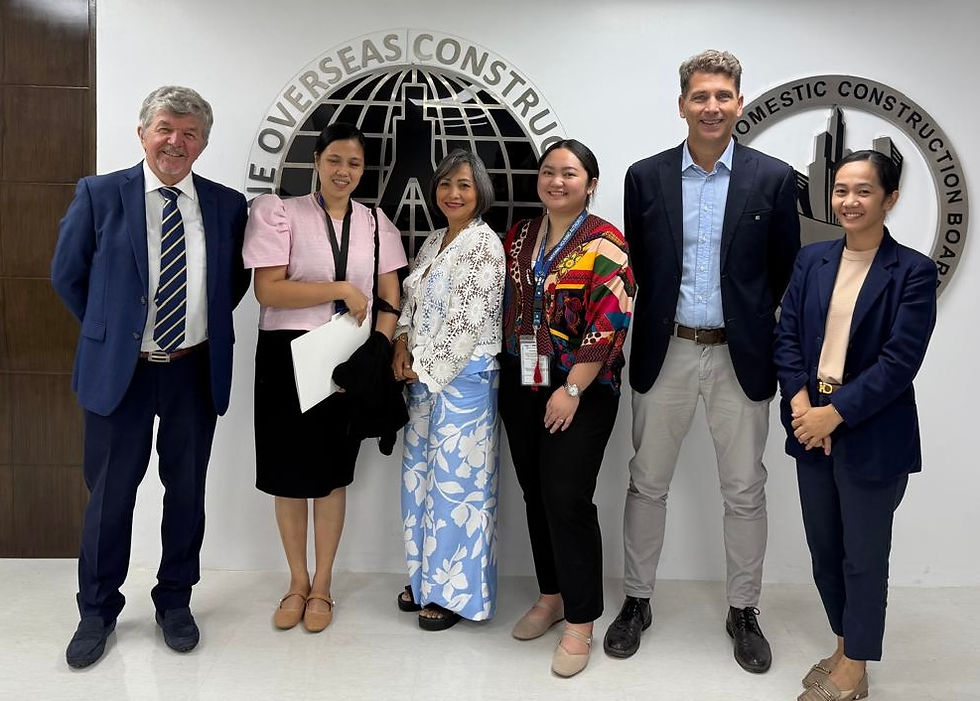
Meetings with POCB . Philippines Oversea Construction Board in Manila.

Meeting with Housing Ministry in Philippines, Manila

Panel discussions at the POCB in Manila with industry leaders

Vetting potential products for the Guild to include in India with Sanjay Manchanda ex CEO Nakheel

His Excellency Nguyen Thanh Diep .. The Ambassador of Vietnam to the UAE. A meeting to discuss mass social housing

One of several meetings with His Excellency Ambassador Alfonso A. Ver from the Philippines in AbuDhabi

Coming together with Indonesia Ambassador to UAE along with Adam Riccio, New Evolution to discuss MMC and potential business.

Meetings in Indonesia with potential projects for Modular and MMC

Visiting EMMEDUE in Italy to review the M2 construction system

More meetings in Manila with Construction Industry leaders hosted by the POCB.

A celebration of Indonesia's independence day in Abu Dhabi with his excellency His Excellency Hussein Basis the Ambassador to the UAE.
