The Need for Community

A GUILD Voice paper by: Andrew J Bannister
The proposition
The home a person lives in, and the community they live within, have a direct and measurable effect on who they are and who they can become. Give a person opportunity and most will take it. Give a person neglect and substandard housing, and most will never have the chance to progress. Some individuals excel regardless of circumstance — but no housing system should be designed around exceptions. It must be designed for the majority, and for the majority, poor housing is not a backdrop to life. It is a limit placed on it.
This paper argues that social and affordable housing must be designed and constructed not simply to shelter people, but to give them the opportunity to build community for themselves — because community is built by residents, never by developers, and the role of design and construction is to make that possible.
The gap is quality as well as volume
The world needs roughly 96,000 affordable homes completed every day to keep pace with need. Formal delivery runs at around half that rate. That is the volume gap, and it is well documented.
The quality gap is less discussed but equally consequential. A significant proportion of what has been delivered — and of what the world's lowest-income families occupy today — is housing in name only: overcrowded, damp, poorly serviced, disconnected from work and schooling. Children grow up in these conditions everywhere. Their resilience is visible; the constraint on their futures is not. The apparent normality of daily life in poor housing is precisely what allows the problem to be underestimated.
The old method of delivery — the method, never the people or governments who worked within it — measured success in units completed. That metric was an honest response to an enormous need, and the units delivered under it have housed millions. But it left a critical question unasked at the point of design: what happens in this place after the keys are handed over?
Why community is the correct measure
Everything that determines whether a housing scheme succeeds over decades happens after handover. The evidence base here is consistent across countries and contexts:
Stable, connected neighbourhoods show better health outcomes, longer school participation, higher employment, and lower demand on health, justice, and crisis services. Schemes that fail — that decline into disrepair, vacancy, and eventual demolition — fail socially before they fail physically. The buildings are usually condemned last.
The mechanism is well understood. Neighbours who know each other share information about work, watch over children and older residents, maintain shared spaces, and hold institutions to account. Economists call it social capital; housing professionals see it as the difference between a scheme that appreciates in value — social and financial — and one that absorbs public money in perpetuity.
Community is therefore not a soft aspiration attached to housing policy. It is the infrastructure that determines the return on every unit built. A scheme designed without regard to it is a scheme designed to underperform.
What design can and cannot do
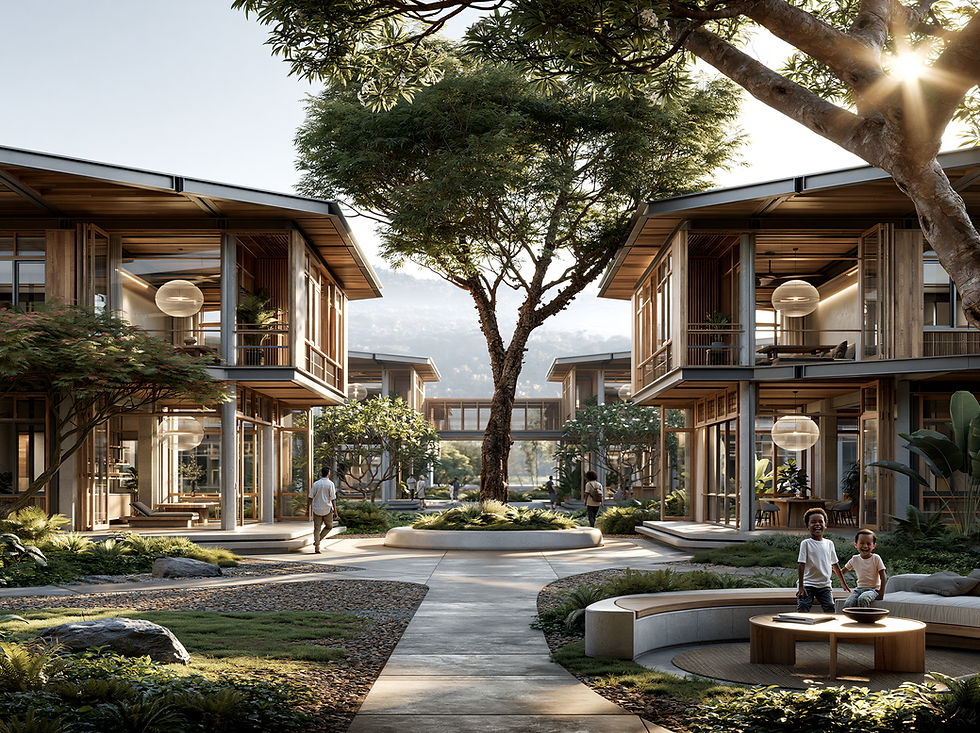
No developer, architect, or government can construct a community. Community is created by residents, through daily acts of contact, exchange, and mutual reliance. What design and construction determine is whether those acts are easy or difficult — whether the built environment makes community probable or improbable.
This reframes the design brief. The question is not "how many units can this land hold?" but "does this layout give residents the opportunity to build a community from it?" That question has specific, buildable answers:
Thresholds. The space between the private home and the public street — doorsteps, porches, entrances that face other entrances — is where neighbour contact begins. Layouts that remove it (blank corridors, doors onto parking, single-purpose circulation) remove the contact with it. This costs little to get right and is nearly impossible to retrofit.
Streets designed for presence, not just movement. Where children can safely occupy the street, adults follow, and informal supervision of the whole neighbourhood results. Traffic-calmed lanes, courtyards overlooked by habitable rooms, and walkable connections to schools and services are the working conditions of community, not amenities added to it.
Shared space with a purpose. Communal space succeeds when residents have a reason to use it and a stake in controlling it — growing space, a hall under resident management, play space, workspace. Undesignated "left-over" open space, by contrast, is consistently the first point of decline in failed schemes.
Adequate internal space. Overcrowding suppresses the outcomes housing is meant to enable: a child cannot study, an adult cannot rest, a household cannot function, in insufficient space. Space standards, daylight, warmth, and acoustic separation are preconditions of opportunity, not luxuries.
Adaptability. Communities change; housing designed as a fixed, finished object obstructs that change. Homes and plots that can be extended, adapted, and personalised allow residents to invest in place — and resident investment is the most reliable indicator of long-term scheme health.
None of these principles is new. Each is supported by decades of post-occupancy evidence. What has been missing is a delivery method capable of applying them at scale without sacrificing volume. That is where modern methods of construction change the equation.
Why MMC changes what is possible
The GUILD's case is that MMC is not merely a faster way to build the same housing. Correctly applied, it resolves the trade-off that constrained the old method — the assumption that volume, quality, and community-oriented design could not be achieved together.
Quality at scale. Factory manufacture delivers consistent, verifiable build quality — thermal performance, acoustic separation, weather-tightness — at volumes site-based methods cannot match. This matters socially as well as technically: build quality is the first signal residents receive about how they are valued, and it shapes how they treat their homes and their neighbourhood in return.
Speed with a social return. Compressed build programmes are usually justified financially. Their larger value is social: every year removed from a family's wait in temporary accommodation is a year of schooling, employment, and stability recovered. Faster delivery directly shortens the period in which communities are dispersed.
Design freedom where it matters. Because off-site manufacture carries the technical complexity — structure, services, performance — design attention and budget can shift to the elements that determine community outcomes: layout, thresholds, streets, shared space. MMC does not standardise neighbourhoods; it standardises components so that neighbourhoods do not have to be.
Resident involvement without compromise. Manufactured systems create defined roles for local labour and resident participation — site assembly, finishing, landscaping — under factory-level quality assurance. Participation in delivery builds local skills, local employment, and resident ownership of the outcome. The old method delivered housing to people; this method can deliver it with them.
Whole-life performance. Schemes fail through maintenance as often as construction. Manufactured homes built from known components to measurable standards remain decent longer and are repaired more predictably — protecting both the public investment and residents' confidence in the institutions that house them.
The ask
To those who commission, fund, design, approve, and manufacture social and affordable housing, the GUILD puts a single, practical request: make community a design requirement, not a hoped-for by-product.
In practice this means three commitments:
Brief for it. Every scheme brief should state, alongside unit numbers and cost, the community outcomes the layout must enable — thresholds, street life, purposeful shared space, adequate internal space, adaptability — and schemes should be assessed against them.
Build for it. Specify delivery methods on whole-life and social performance, not lowest capital cost. MMC should be evaluated on what it uniquely enables — quality at volume, speed of return to permanence, resident participation — not treated as a like-for-like substitute for the old method.
Hand over more than keys. Delivery should end with residents holding not just tenancies but a stake: managed shared space, participation in finishing works, and homes capable of adaptation.
None of this requires new technology or new evidence. Both exist. It requires only that the question asked at the start of every scheme be changed — from how many units the land will hold, to what kind of community the place will make possible.
The majority of people in housing need do not need rescuing. They need a decent home, a functioning neighbourhood, and the opportunity to build the rest themselves. Housing that provides those three things repays its investment for generations. Housing that provides only the first must be paid for again and again.
The GUILD exists to make the better outcome buildable, at scale, now.
The GUILD of MMC is a global movement for making affordable and social housing happen through modern methods of construction. www.guildmmc.com


Comments